
Arlington officials are exploring areas within the city’s boundaries where data centers could be located and standards regulating their operation, should developers show interest.
In a Tuesday meeting, Arlington City Council members were for the first time presented with proposed ordinances that outlined the zoning districts where certain data centers would be based.
The proposed ordinances detailed regulations for data centers that would operate primarily out of their own buildings, in shared spaces and those that act as accessories — or sit adjacent — to larger infrastructure.
Council members first received a presentation in late September about the different types of data centers and which of these the city was most likely to see.
Land development assistant director Kenneth Bloom explained that a set of ordinances was created for data centers across the three kinds of development based on the types of hubs most likely to operate in Arlington given the city’s limited land availability.
For example, a data center operating in its own building with the most likelihood of setting up shop in Arlington would be an enterprise facility, according to city documents. These centers typically require 5 to 10 acres. An enterprise facility is often wholly operated by a single company to process internal data and operations. Homebuilder D.R. Horton’s facility, located off Interstate 30 in north Arlington, is an example of an enterprise data center.
Data centers in stand-alone buildings would only be permitted in light industrial and industrial manufacturing-zoned districts, accompanied by a specific use permit. Stand-alone data centers would be allowed in planned development-zoned districts as long as the project is specifically identified, according to city documents.
Additionally, these facilities would have to comply with further regulations, including maintaining a distance of at least 300 feet from homes and a building height of no more than 75 feet. Stand-alone centers would also be prohibited from using evaporative cooling.
Enterprise or stand-alone data centers would be required to comply with limits on daytime and nighttime noise levels and conduct testing before and after construction, city staffers proposed.
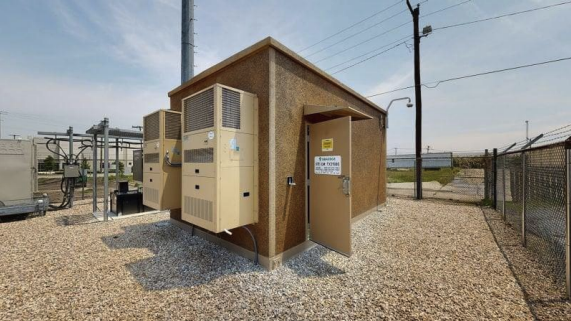 Edge data centers are smaller facilities located near end users to process data locally and reduce network delays. (Courtesy | City of Arlington)
Edge data centers also have a high probability of being built in Arlington. These facilities would be what Bloom described as equipment box-accessories, operating either inside or near a larger building. Bloom compared these data centers to equipment boxes found directly next to cell towers.
No cooling regulations were proposed for the equipment box-like data centers, but they would be limited to a surface area of 200 square feet and not measure more than 12 feet in height.
Co-located data centers would likely operate as accessories in buildings with multiple tenants, according to a Sept. 29 council agenda, but these facilities have moderate chances of coming to Arlington.
City staffers propose accessory-designated data centers to operate in any nonresidential zoning, but they must be tied to the building’s primary use.
“A financial services company might have three stories in the building that they might use, one for their data center uses,” Bloom said, detailing a scenario in which a data center would act as an accessory.
Accessory-designated data centers would be prohibited from equipping evaporate cooling and outdoor backup power generators, such as diesel-generated power sources, city documents show. However, depending on their size, the centers would be permitted battery energy storage systems. The technology is compared to that of a large battery, storing energy from the electric grid for later use in the event of a power outage.
Council member Brittney Garcia-Dumas asked Bloom how proposed ordinances were crafted, later stating she wants data centers located “as far away” from homes and residents as possible.
“These things kind of came about just from research and from other ordinances around the country and around the state,” Bloom said. “Again, kind of tailored to what Arlington’s needs really would be.”
Garcia-Dumas said she supports the city’s proposed regulations on noise before granting permits, considering how residents’ quality of life can be affected.
“I’m in favor of the modeling … so that we can really look out for our residents as we are also looking out for our economic future,” Garcia-Dumas said.
Before Bloom addressed Garcia-Dumas’ questions, Bloom said regulations and ordinances are subject to change.
“This is a work in progress. The technology changes every day,” Bloom said.
Nicole Lopez is the environment reporter for the Fort Worth Report. Contact her at nicole.lopez@fortworthreport.org.
The Report’s environment coverage is supported by the Marilyn Brachman Hoffman Foundation.
At the Fort Worth Report, news decisions are made independently of our board members and financial supporters. Read more about our editorial independence policy here.
This article first appeared on Fort Worth Report and is republished here under a Creative Commons Attribution-NoDerivatives 4.0 International License. 